
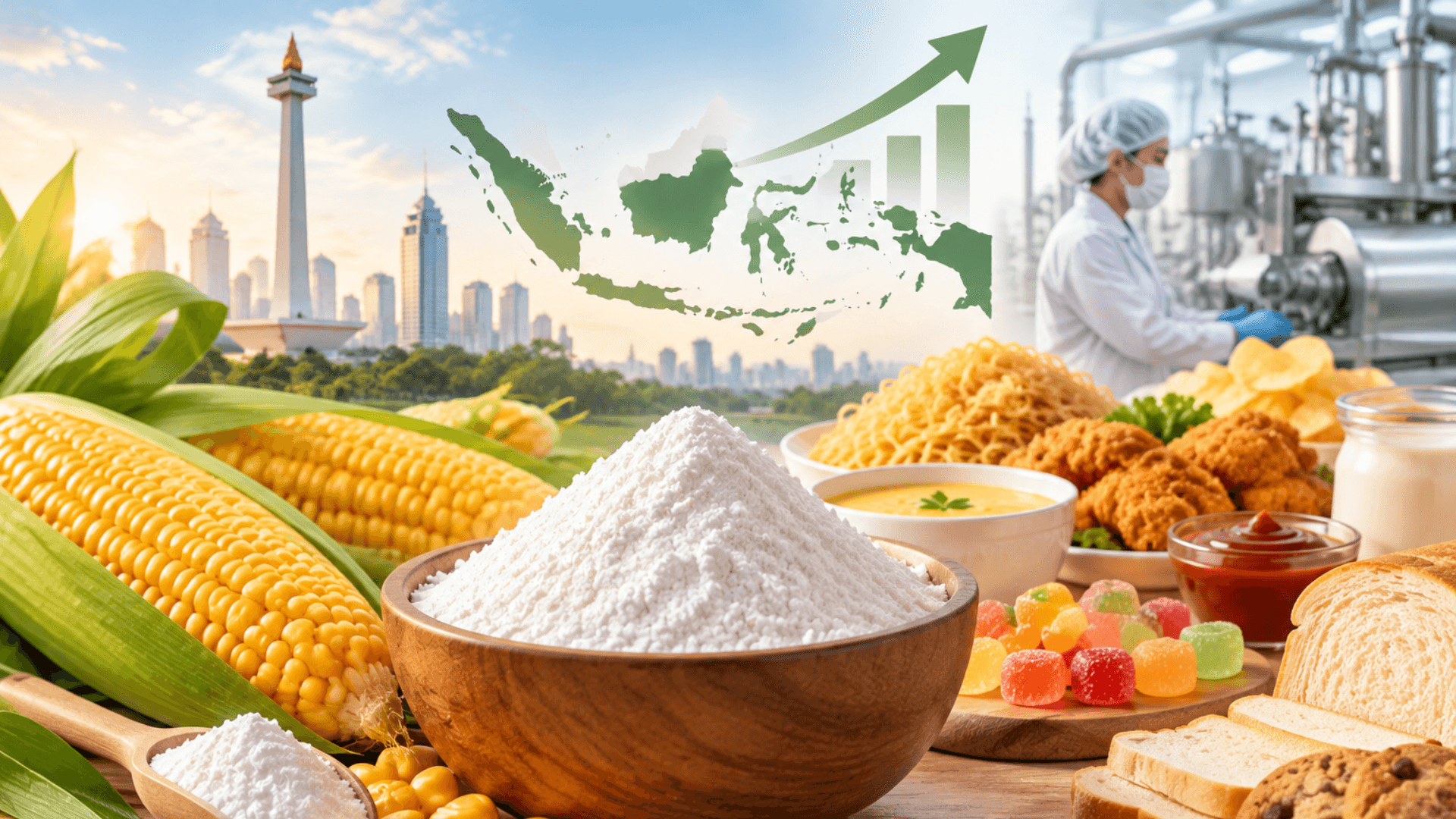
Introduction: Why Modified Corn Starch Matters
Indonesia’s food industry is entering a stage where ingredient functionality is becoming increasingly important alongside cost competitiveness. Food manufacturers are looking for ingredients that can deliver consistent texture, improve processing stability, control viscosity, retain moisture, and maintain product quality throughout storage and distribution. This has created growing opportunities for functional ingredients such as modified corn starch.
Modified corn starch is particularly relevant because native corn starch does not always perform reliably under demanding industrial conditions. Exposure to high temperatures, acidity, mechanical shear, freezing and thawing, or prolonged processing can affect the viscosity and texture provided by native starch. Modification allows starch to be engineered for specific food-processing requirements, making it a valuable ingredient across sauces, bakery products, instant foods, dairy products, processed meat, frozen foods, snacks, and other applications.
The opportunity is significant in Indonesia because of the country's large and diverse food-processing sector. The U.S. Department of Agriculture estimates Indonesia's food-processing industry at approximately US$101 billion in 2026, while also identifying cornstarch among ingredients with good sales potential in the market. Indonesia's expanding packaged-food sector, modern retail channels, convenience-food consumption, and increasingly sophisticated food manufacturing base are supporting demand for functional ingredients.
Trade data also demonstrates the importance of international starch suppliers. Indonesia imported approximately 167,843 metric tons of modified starch products under HS 350510 in 2024, valued at around US$172.3 million. Thailand was the dominant supplier, followed by China, the United States, the Netherlands, and several European and Asian origins. Because HS 350510 includes modified starches from different botanical sources, this figure should be viewed as the broader modified-starch market rather than modified corn starch alone.
For international suppliers, Indonesia therefore represents an attractive market where technical performance, regulatory compliance, competitive pricing, and reliable supply can all create opportunities.
Understanding Modified Corn Starch
Modified corn starch is produced by changing the physical, chemical, enzymatic, or other permitted characteristics of native corn starch to improve its functionality. Native starch already provides thickening, binding, and gelling properties, but its performance can become unstable under certain processing conditions.
Modification can improve resistance to heat, acid, and mechanical shear while also providing better freeze-thaw stability, water retention, controlled viscosity, and specific textural characteristics. Depending on the modification method, manufacturers can select starches designed for different applications and processing environments.
Indonesia's BPOM food-category system recognizes Pati Termodifikasi, or modified starch, under food category 06.2.2. The category includes starches whose molecular structure has been modified to obtain improved functional properties. International food-additive standards likewise recognize different types of modified starches, including oxidized starch, acid-treated starch, enzyme-treated starch, starch phosphates, acetylated starches, hydroxypropyl starch, and other specialized forms.
From a commercial perspective, however, the most important characteristic is not the modification process itself but the function delivered to the food manufacturer. A sauce producer may require acid and heat stability, while a frozen-food manufacturer may prioritize freeze-thaw performance. A bakery producer may focus on moisture retention, whereas a processed-meat manufacturer may require water binding and improved texture.
Why Indonesia Offers Strong Market Potential
Indonesia has one of Southeast Asia's largest food-processing industries, supported by a population exceeding 280 million people and increasing consumption of packaged and convenience foods. USDA's assessment of the Indonesian food-processing industry places its value at around US$101 billion in 2026, highlighting the continued opportunity for imported food ingredients.
The country's food industry is highly diversified. Major manufacturing segments include instant noodles, sauces, seasonings, bakery products, biscuits, confectionery, dairy products, processed meat, seafood, frozen foods, snacks, and ready-to-eat meals. This diversification is important for modified starch suppliers because demand does not depend on a single application.
Indonesia's retail-food market is also expanding. Modern retail, convenience stores, e-commerce, and food-delivery channels are increasing the importance of packaged products with consistent quality and shelf stability. Food manufacturers therefore need ingredients that can perform consistently at industrial scale.
Modified starch can help address these requirements. Instead of functioning only as a thickener, it can support viscosity control, water management, texture, stability, and processing efficiency. This makes it increasingly relevant as Indonesian manufacturers develop more sophisticated formulations.
Modified Corn Starch Applications in Indonesia
Sauces, Dressings and Condiments
Sauces are among the most important applications for modified corn starch in Indonesia. The country has a large market for chili sauce, tomato sauce, mayonnaise, salad dressing, gravy, seasoning sauce, instant-noodle sauce, and other condiments.
These products require controlled viscosity and stability. A sauce that becomes too thin after heating or separates during storage can create significant quality problems. Modified corn starch can provide more reliable thickening under industrial conditions and can be selected for resistance to heat, acid, and shear.
For retorted or hot-filled sauces, this functionality is particularly valuable. The starch must maintain its performance throughout cooking and filling rather than only during laboratory formulation. In dressings and emulsified products, starch can also contribute to body and stability while helping manufacturers achieve the desired sensory characteristics.
Instant Noodles and Convenience Foods
Indonesia is one of the world's major instant-noodle markets, making convenience foods an important opportunity for starch suppliers. Modified starch can contribute to noodle texture, water absorption, cooking characteristics, and overall formulation performance.
It can also be used in noodle sauces, soup bases, and seasoning systems where viscosity and stability need to remain consistent during processing and consumption. As manufacturers compete on texture and eating experience, functional starches can become an important formulation tool.
The same principle applies to other convenience foods and ready-to-eat meals. Modified starch can help create products that are easier to process, store, reheat, and distribute.
Bakery and Confectionery
Indonesia's growing bakery industry provides another important market. Modified corn starch can contribute to moisture retention, crumb softness, texture, structure, and stability in bread, cakes, biscuits, pastries, fillings, and cream systems.
In bakery applications, starch interacts with water and other ingredients during mixing and baking. A suitable modified starch can help control these interactions and maintain desirable texture during storage.
For biscuits and cookies, starch functionality can influence crispness, bite, spread, and structure. In fillings and cream systems, it can provide viscosity and stability. These functions are increasingly relevant as industrial bakeries seek consistent quality across high-volume production.
Dairy Products and Desserts
Modified corn starch can also be used in dairy and dairy-alternative products, including puddings, custards, dessert preparations, flavored dairy products, and yogurt-style formulations.
One of its main functions is viscosity control. Consumers expect dairy desserts and similar products to have smooth, stable textures without excessive separation. Modified starch can provide body while allowing manufacturers to control the final mouthfeel.
Freeze-thaw stability is particularly important for frozen desserts and products exposed to temperature fluctuations. Appropriate modified starches can help minimize syneresis and texture deterioration during storage and distribution.
Processed Meat and Seafood
Processed meat, poultry, and seafood products are another important application. Products such as sausages, meatballs, nuggets, patties, and surimi-based foods require ingredients that contribute to binding, water retention, structure, and texture.
Modified corn starch can help retain moisture during processing and cooking while contributing to product firmness and consistency. This can improve both sensory quality and manufacturing efficiency.
Because Indonesian consumers have strong demand for processed protein products, this application represents a potentially significant market for specialized modified starch grades.
Frozen Foods and Ready Meals
Frozen food is particularly suitable for modified starch because freezing and thawing can create significant challenges for starch-based formulations. Native starch may experience syneresis or texture deterioration after repeated temperature changes.
Modified starches designed for freeze-thaw stability can help maintain sauce consistency, filling structure, and overall product quality. This is valuable for frozen meals, frozen snacks, prepared foods, and frozen protein products.
Indonesia's tropical climate and geographically dispersed distribution network make stability especially important. Ingredients that maintain performance despite temperature fluctuations can help manufacturers reduce quality problems throughout the supply chain.
Snacks and Coatings
Modified corn starch can also be used in snacks and coating systems to influence adhesion, crispness, expansion, oil absorption, and surface texture.
For coated snacks and fried products, starch can help create a consistent coating and influence the interaction between the food surface, coating, and frying medium. As Indonesia's packaged-snack industry continues to grow, these functionality requirements create additional opportunities.
Indonesia's Modified Starch Demand Outlook
The long-term demand for modified corn starch is closely connected to Indonesia's expanding processed-food industry. As manufacturers scale up production, automate processes, extend distribution, and develop longer-shelf-life products, the need for predictable ingredient performance increases.
Third-party market research estimates that Indonesia's modified food starch market could grow at approximately 5.5–7.0% annually through 2035, driven by processed foods, convenience products, sauces, bakery, dairy, meat, snacks, and other applications. These figures are commercial market estimates rather than official government statistics, but they support the broader trend observed in Indonesia's food-processing sector.
Demand is therefore likely to be strongest in applications where native starch cannot consistently deliver the required performance. Heat-resistant sauce systems, frozen foods, processed meat, bakery fillings, dairy desserts, instant foods, and other technically demanding formulations provide opportunities for higher-value modified starch products.
Where Does Indonesia Import Modified Starch From?
Indonesia has a well-established international supply chain for modified starches. According to World Bank WITS data based on UN Comtrade, Indonesia imported around 167,843 metric tons under HS 350510 in 2024, worth approximately US$172.3 million.
Thailand was the leading supplier, exporting approximately 117,374 metric tons to Indonesia with a value of about US$97.4 million. China followed with approximately 20,951 metric tons, worth around US$23.2 million, while the United States supplied approximately 5,368 metric tons, valued at around US$13.8 million. The Netherlands supplied approximately 5,787 metric tons, worth around US$9.8 million.
Indonesia also sourced modified starch products from Sweden, Germany, India, Denmark, Italy, Vietnam, France, Singapore, Malaysia, Japan, South Korea, Brazil, and other countries.
Thailand's strong position is understandable because of its large starch-processing industry, agricultural raw-material base, proximity to Indonesia, established export infrastructure, and competitive logistics. China also benefits from manufacturing scale and a broad range of modified-starch products.
European suppliers can be more relevant for specialized applications where technical specifications, certifications, consistency, and formulation support are particularly important.
It is important to note that HS 350510 does not represent modified corn starch alone. The classification covers dextrins and other modified starches from different sources. Therefore, the US$172.3 million figure should not be interpreted as the exact value of Indonesia's modified corn starch market.
Native Corn Starch Versus Modified Corn Starch
Native and modified corn starch should also be separated when evaluating Indonesian trade flows.
Indonesia imported approximately 249,202 metric tons of maize starch under HS 110812 in 2024, worth approximately US$109.6 million. India was the largest supplier, followed by Ukraine and several other origins.
Modified starch, meanwhile, is generally classified under HS heading 3505, with HS 350510 covering dextrins and other modified starches. This distinction is commercially important because native corn starch import statistics cannot be directly used to calculate modified corn starch demand.
For suppliers and Indonesian buyers, the correct customs classification should be confirmed according to the exact characteristics and modification of the product before shipment.
How to Import Modified Corn Starch into Indonesia
Indonesia's import requirements involve customs, trade, food-safety, and halal considerations. The exact requirements depend on the product's classification, intended use, formulation, and applicable regulations.
At the customs level, Indonesia's BTKI, or Indonesian Customs Tariff Book, provides the framework for tariff classification and import treatment. Modified starches generally fall under HS heading 3505, but the specific classification should be verified according to the product.
Indonesia's current import-policy framework is governed by Minister of Trade Regulation No. 16 of 2025 concerning Import Policy and Regulation, which was subsequently amended by Minister of Trade Regulation No. 37 of 2025. Importers must comply with the applicable importer-registration and licensing requirements through Indonesia's trade and customs systems.
The importer must also complete customs clearance procedures, including submission of the relevant Import Declaration, payment of applicable import duties and taxes, and provision of required commercial and shipping documentation.
For food-grade modified corn starch, regulatory preparation should ideally take place before shipment. The supplier should provide a clear product identity, specification, Certificate of Analysis, technical data sheet, microbiological specifications, heavy-metal specifications, allergen information, GMO statement where applicable, and relevant manufacturing or processing information.
BPOM and Food-Safety Compliance
Modified starch intended for food applications falls within Indonesia's food regulatory framework. BPOM's food-category system recognizes modified starch under food category 06.2.2.
The applicable regulatory requirements should be assessed according to the ingredient's identity and intended application. Indonesian manufacturers using the ingredient must also ensure that their finished food products comply with applicable BPOM requirements.
For imported food-related products, BPOM Regulation No. 28 of 2023 amended the previous regulation governing the supervision of food and other regulated products entering Indonesia. Meanwhile, BPOM Regulation No. 23 of 2023 governs the registration of processed foods.
This means suppliers should work closely with the Indonesian importer to determine whether the specific product and intended use require additional BPOM documentation or registration-related procedures.
A strong regulatory package can significantly simplify customer qualification. Providing complete technical documentation before commercial discussions can help Indonesian buyers evaluate the ingredient more efficiently.
Halal Requirements for Modified Corn Starch
Halal compliance has become increasingly important for imported food ingredients in Indonesia. Indonesia's halal framework covers not only finished foods but also relevant raw materials, food additives, and processing aids.
BPJPH has announced that mandatory halal implementation will expand further from 18 October 2026, including applicable imported products and food-related raw materials, additives, and processing aids.
This is particularly important for modified corn starch because the final ingredient may involve processing agents or other materials depending on the modification method. The fact that the primary raw material is corn does not automatically eliminate the need to evaluate the complete production process.
For international suppliers, halal certification and transparent documentation can therefore become an important commercial advantage. Suppliers should prepare relevant halal documentation and confirm recognition requirements with the Indonesian importer and BPJPH framework before entering the market.
What Indonesian Buyers Expect From Suppliers
Indonesian food manufacturers increasingly evaluate modified starch based on total functionality rather than price alone. A lower-priced starch may not provide a real cost advantage if it requires a higher dosage, produces inconsistent viscosity, or creates processing and quality problems.
Consistency is therefore critical. Manufacturers need predictable performance from batch to batch, particularly in high-volume production.
Application suitability is equally important. A starch designed for bakery products may not perform well in acidic sauces, while a grade developed for high-temperature processing may not provide the required characteristics in frozen food.
Documentation is another major consideration. Large Indonesian manufacturers, especially those supplying multinational brands or export markets, may require technical specifications, certificates, traceability information, halal certification, GMO statements, and other compliance documents.
Reliable logistics are also important. Indonesia's geography means that lead time, port selection, container availability, inventory planning, and local distribution can influence the competitiveness of an imported ingredient.
The Opportunity for Global Modified Starch Suppliers
Indonesia's market offers opportunities for suppliers that can combine competitive pricing with differentiated functionality. Thailand's dominant position demonstrates the importance of proximity and logistics, but Indonesian manufacturers also require specialty grades for increasingly sophisticated formulations.
The strongest commercial proposition is therefore often application-driven. Rather than positioning modified corn starch simply as a thickener, suppliers can demonstrate how a specific grade can improve viscosity retention, freeze-thaw stability, moisture management, water binding, texture, or processing efficiency.
Technical support can also create differentiation. A supplier capable of helping customers select the appropriate starch grade, dosage, and processing conditions can create greater value than a supplier competing only on price.
As Indonesia's food industry continues to modernize, the market should increasingly favor functional ingredients that solve measurable formulation problems.
Conclusion: A Growing Market for Functional Starch
Modified corn starch is becoming an increasingly relevant ingredient for Indonesia's food-processing industry. The combination of a large domestic food market, expanding packaged-food consumption, industrial-scale manufacturing, and growing demand for consistent product quality creates a strong foundation for future demand.
Indonesia's approximately US$101 billion food-processing industry provides a broad customer base, while the country's modified-starch imports demonstrate its established dependence on international supply chains. In 2024, Indonesia imported approximately 167,843 metric tons of products under HS 350510, valued at around US$172.3 million, with Thailand serving as the dominant origin.
For modified corn starch specifically, the most attractive applications include sauces and condiments, instant foods, bakery and confectionery, dairy products, processed meat and seafood, frozen foods, ready meals, snacks, and coating systems. Across these categories, the key value proposition is functionality: better stability, controlled viscosity, water management, texture, and consistent processing performance.
For suppliers entering Indonesia, understanding the distinction between native corn starch under HS 1108.12 and modified starch under HS 3505 is essential. Equally important are accurate customs classification, applicable import requirements, BPOM food-safety considerations, technical documentation, and halal compliance.
As Indonesian food manufacturers continue to develop more sophisticated products, modified corn starch has the potential to move from a specialized formulation ingredient to an increasingly important component of industrial food production.
Meet Us at Fi Asia Indonesia 2026
Tradeasia International is ready to support food manufacturers, distributors, and sourcing partners looking for reliable functional food ingredients for the Indonesian market. If you are evaluating modified corn starch for sauces, bakery, dairy, processed meat, instant foods, frozen products, or other applications, our team can discuss suitable grades, specifications, sourcing options, and technical requirements.
We are pleased to announce that Tradeasia International will be exhibiting at Fi Asia Indonesia 2026 at JIExpo Kemayoran, Jakarta. Visit us at Booth C3L38, Hall C3, to meet our team and discuss your food-ingredient sourcing requirements.
For inquiries and business discussions, contact us at marketing@foodingredientsasia.com.